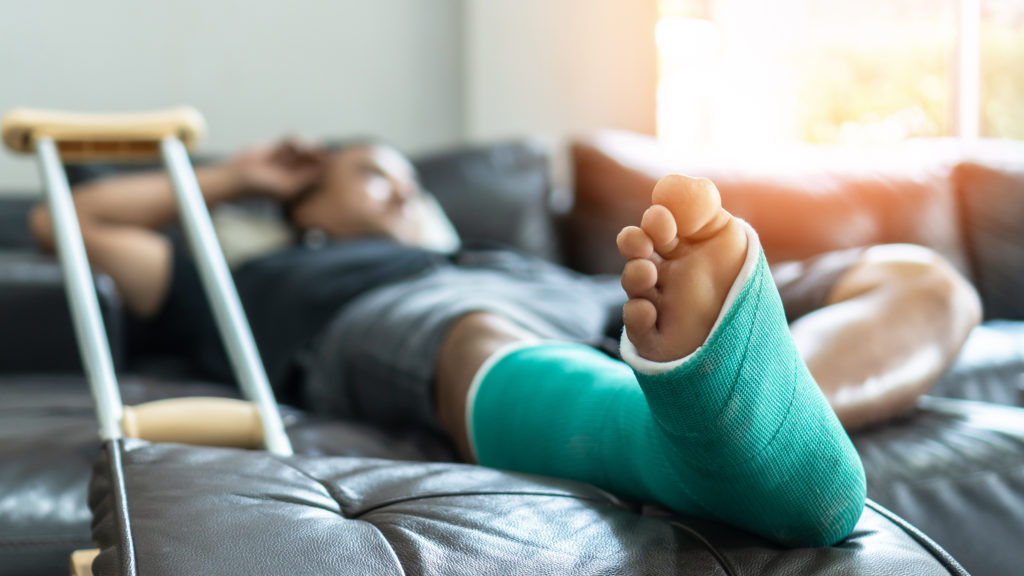
Fractures can also affect a healthy bone in case of a strong trauma, but often they appear against the background of the pre-existence of an osteoporosis process.
Fracture is defined as a discontinuity in bone structure, complete or partial, caused by a trauma that can be high intensity, producing fractures on healthy bones, or low intensity, acting on previously weakened bones (through osteoporosis, osteopenia, tumors bone, osteitis), in which case it is called a pathological fracture.
Healing of bones, whether they have been fractured or cut as part of a surgery, is done by forming the callus that follows the same steps:
- Inflammatory – begins immediately after the fracture and lasts for several days. With the bone rupture, there are ruptures of the blood vessels, forming a local hematoma. It is infiltrated with fibrovascular tissue, which creates a matrix for callus formation and gives the bone initial stability.
- The repair phase – begins when the hematoma is replaced with fibrous tissue and cartilage, the so-called soft callus. It will be populated with bone cells, organizing into the hard callus. This stage can last up to a few weeks. The hard callus is weaker than bone tissue but can withstand external forces, representing the stage of clinical healing.
- The bone remodeling phase – is the longest and lasted from a few weeks to several years. At this stage, the bone continues to strengthen, gradually replacing the callus, and at the same time, a bone remodeling takes place to get as close as possible to its physiological shape.
To heal properly, the bones must be anatomically positioned and immobilized. Depending on the type of fracture, healing can take up to a year, with an average healing time of 6-8 weeks. Healing fractures in children follows the same steps, but at a higher rate.
Complications of an untreated fracture include:
- Abnormal healing
- Loss of function
- Bone weakening
- The formation of blood clots near the vessels
- Infection at the fracture site
- Lesions of the skin, tissues, and muscles around the fracture
- Swelling of adjacent joints by the accumulation of blood in the joints
- Fatty emboli – found in fractures of long bones, such as the thigh bone, femur. Cells are transported to the lungs of the lungs can cause respiratory distress that, untreated, can be life-threatening.
Ways of treating fractures – depend on the location and type of fracture
- Immobilization in traditional plaster casts of resin – ensures immobilization and maintenance of position during healing
- Orthosis immobilization-means that minimal motion is preserved in neighboring joints. Based on the form of injury, a typical immobilization is determined by a specialist at the first step of the operation, and an orthosis may either be used to allow speedy movement or orthosis is only prescribed for the duration of the care.
- Surgery – open reduction and fixation with plates and screws or metal rods, in complex fractures or in fractures that are not suitable for treatment by immobilization.
Learn more about broken bone healing burning sensation.
 The Creative Journal